
Driving a 7-segment LED Display
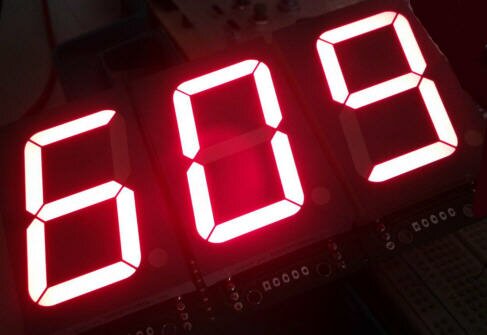
Although a 7-segment LED Display can be thought of as a single display, it is still seven individual LEDs within a single package and as such these LEDs need protection from over current. LEDs produce light only when it is forward biased with the amount of light emitted being proportional to the forward current.
This means then that an LEDs light intensity increases in an approximately linear manner with an increasing current. So this forward current must be controlled and limited to a safe value by an external resistor to prevent damage to the LED segments.
The forward voltage drop across a red LED segment is very low at about 2-to-2.2 volts, (blue and white LEDs can be as high as 3.6 volts) so to illuminate correctly, the LED segments should be connected to a voltage source in excess of this forward voltage value with a series resistance used to limit the forward current to a desirable value.
Typically for a standard red coloured 7-segment display, each LED segment can draw about 15 mA to illuminated correctly, so on a 5 volt digital logic circuit, the value of the current limiting resistor would be about 200Ω (5v – 2v)/15mA, or 220Ω to the nearest higher preferred value.
So to understand how the segments of the display are connected to a 220Ω current limiting resistor consider the circuit below.

Driving a 7-segment Display
In this example, the segments of a common anode display are illuminated using the switches. If switch a is closed, current will flow through the “a” segment of the LED to the current limiting resistor connected to pin a and to 0 volts, making the circuit. Then only segment a will be illuminated. So a LOW condition (switch to ground) is required to activate the LED segments on this common anode display.
But suppose we want the decimal number “4” to illuminate on the display. Then switches b, c, f and g would be closed to light the corresponding LED segments. Likewise for a decimal number “7”, switches a, b, c would be closed. But illuminating 7-segment displays using individual switches is not very practical.
7-segment LED Displays are usually driven by a special type of integrated circuit (IC) commonly known as a 7-segment decoder/driver, such as the CMOS 4511. This 7-segment display driver which is known as a Binary Coded Decimal or BCD to 7-segment display decoder and driver, is able to illuminate both common anode or common cathode displays. But there are many other single and dual display drivers available such as the very popular TTL 7447.
This BCD-to-7 segment decoder/driver takes a four-bit BCD input labelled A, B, C and D for the digits of the binary weighting of 1, 2, 4 and 8 respectively, has seven outputs that will pass current through the appropriate segments to display the decimal digit of the numeric LED display.
The digital outputs of the CD4511 are different from the usual CMOS outputs because they can provide up to 25mA of current each to drive the LED segments directly allowing different coloured LED displays to be used and driven.

Driving a 7-segment Display using a 4511
In this simple circuit, each LED segment of the common cathode display has its own anode terminal connected directly to the 4511 driver with its cathodes connected to ground. The current from each output passes through a 1kΩ resistor that limits it to a safe amount. The binary input to the 4511 is via the four switches. Then we can see that using a BCD to 7-segment display driver such as the CMOS 4511, we can control the LED display using just four switches (instead of the previous 8) or a 4-bit binary signal allowing up to 16 different combinations.
Most digital equipment use 7-segment Displays for converting digital signals into a form that can be displayed and understood by the user. This information is often numerical data in the form of numbers, characters and symbols. Common anode and common cathode seven-segment displays produce the required number by illuminating the individual segments in various combinations.
LED based 7-segment displays are very popular amongst Electronics hobbyists as they are easy to use and easy to understand. In most practical applications, 7-segment displays are driven by a suitable decoder/driver IC such as the CMOS 4511 or TTL 7447 from a 4-bit BCD input. Today, LED based 7-segment displays have been largely replaced by liquid crystal displays (LCDs) which consume less current.