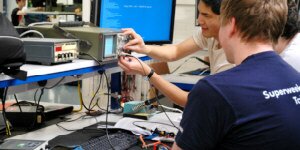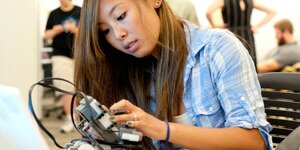


Electricity is all around us. We have electric lights, electric clocks, we have mobilephones, calculators, television, V-recorders, CD-players, MP3-players, radio, computers. Light it self is an electromagnetic phenomenon, as radio waves are. The colors of the ribbon on the blue sky are they because of electricity.
Walter Lewin
Computer Technology is the study of the hardware and software that are the foundations of modern computer systems. Computers are now a fundamental part of everyday lives, controlling everything from toasters to nuclear power stations. The need to build and deploy effective computing infrastructure is now crucial to business and other organisations.
Operating systems are computer programs that control computers - allowing us to store information and run application software. They must support new hardware with multiple processors, ever faster and larger memories and a myriad of accessories and add-ons. You’ll go beyond Microsoft Windows to learn about alternative operating systems, how operating systems work, and how to set up secure systems.
Modern computer systems depend on the networks that interconnect them. Once built on telephone lines, these networks now run on optical fi bres and carry millions of voice and video conversations. The demand for people who have the skills to build new and better networks is ever expanding; today’s applications require more speed, mobility, reliability and capacity than yesterday’s, and tomorrow’s networks will even more. You’ll gain those skills - learning from networks lecturers who have signifi cant industry experience themselves, and who can show you cutting-edge research and development in this field.
Electrical engineers design, develop, test and supervise the manufacturing of electrical equipment, such as electric motors, radar and navigation systems, communications systems and power generation equipment.
 If it's a practical, real-world device that produces, conducts or uses electricity, in all likelihood, it was designed by an electrical engineer. Additionally, engineers may conduct or write the specifications for destructive or nondestructive testing of the performance, reliability and long-term durability of devices and components.
Today’s electrical engineers design electrical devices and systems using basic components such as conductors, coils, magnets, batteries, switches, resistors, capacitors, inductors, diodes and transistors. Nearly all electrical and electronic devices, from the generators at an electric power plant to the microprocessors in your phone, use these few basic components.
Critical skills needed in electrical engineering include an in-depth understanding of electrical and electronic theory, mathematics and materials. This knowledge allows engineers to design circuits to perform specific functions and meet requirements for safety, reliability and energy efficiency, and to predict how they will behave, before a hardware design is implemented. Sometimes, though, circuits are constructed on "breadboards," or prototype circuit boards made on computer numeric controlled (CNC) machines for testing before they are put into production.
Electrical engineers are increasingly relying on computer-aided design (CAD) systems to create schematics and lay out circuits. They also use computers to simulate how electrical devices and systems will function. Computer simulations can be used to model a national power grid or a microprocessor; therefore, proficiency with computers is essential for electrical engineers. In addition to speeding up the process of drafting schematics, printed circuit board (PCB) layouts and blueprints for electrical and electronic devices, CAD systems allow for quick and easy modifications of designs and rapid prototyping using CNC machines. A comprehensive list of necessary skills and abilities for electrical and electronics engineers can be found at TESLA INSTITUTE.
Nikola Tesla (Serbian Cyrillic: Никола Тесла) 10 July 1856 – 7 January 1943) was a Serbian American inventor, electrical engineer, mechanical engineer, and futurist best known for his contributions to the design of the modern alternating current (AC) electricity supply system.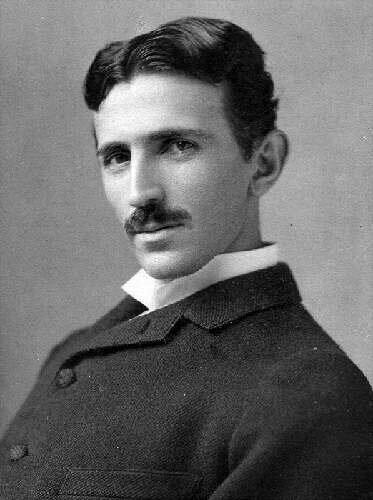
Tesla gained experience in telephony and electrical engineering before immigrating to the United States in 1884 to work for Thomas Edison in New York City. He soon struck out on his own with financial backers, setting up laboratories and companies to develop a range of electrical devices. His patented AC induction motor and transformer were licensed by George Westinghouse, who also hired Tesla for a short time as a consultant. His work in the formative years of electric power development was also involved in the corporate struggle between making alternating current or direct current the power transmission standard, referred to as the war of currents. Tesla went on to pursue his ideas of wireless lighting and electricity distribution in his high-voltage, high-frequency power experiments in New York and Colorado Springs and made early (1893) pronouncements on the possibility of wireless communication with his devices. He tried to put these ideas to practical use in his ill-fated attempt at intercontinental wireless transmission; his unfinished Wardenclyffe Tower project. In his lab he also conducted a range of experiments with mechanical oscillator/generators, electrical discharge tubes, and early X-ray imaging. He even built a wireless controlled boat which may have been the first such device ever exhibited.
Tesla was renowned for his achievements and showmanship, eventually earning him a reputation in popular culture as an archetypal "mad scientist." His patents earned him a considerable amount of money, much of which was used to finance his own projects with varying degrees of success. He lived most of his life in a series of New York hotels, through his retirement. He died on 7 January 1943. His work fell into relative obscurity after his death, but in 1960 the General Conference on Weights and Measures named the SI unit of magnetic flux density the tesla in his honor. Tesla has experienced a resurgence in interest in popular culture since the 1990s.
Subcategories
Nikola Tesla
Nikola Tesla (Serbian Cyrillic: Никола Тесла) 10 July 1856 – 7 January 1943) was a Serbian American inventor, electrical engineer, mechanical engineer, and futurist best known for his contributions to the design of the modern alternating current (AC) electricity supply system.