



TESLA Institute
What is EMI and how can you prevent it ?
 Electromagnetic interference (EMI) is an electromagnetic emission that causes a disturbance in another piece of electrical equipment. EMI can be attributed to a wide span of the electromagnetic spectrum including radio, DC and even microwave frequencies. Because anything that carries rapidly changing electrical currents gives off electromagnetic emissions, it is quite common for one object’s emissions to “interfere” with another’s.
Band structure of III-V and group IV semiconductors
Group IV semiconductors (Si,Ge)
The band structure of these semiconductors is very similar because:
- They do crystallize in the same crystallographic structure (diamond)
- They have similar electronic outer orbitals
The structure of silicon is purely covalent. The last orbital of atomic silicon has the electronic configuration 3s2p2. There are therefore 4 electrons (2s et 2p) sharing an orbital that could contain 8 (2 for the s orbital, 6 for the p orbital). Silicon has therefore 4 valence bands. The band structure of silicon and germanium, two most important semiconductors formed using the column IV of the periodic table, is shown in Fig. 2.4.
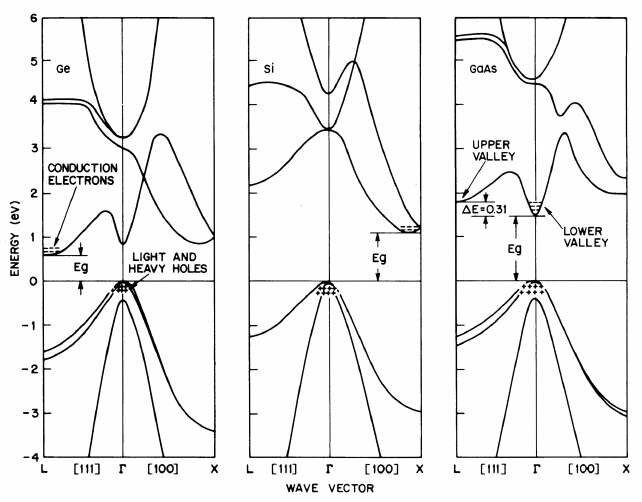
Figure 2.4: Germanium (left), Silicon (center) and Gallium Arsenide (right) band structures.
The valence band maximum is at k = 0 and is degenerate with the heavy and light hole bands. A third important valence band is the “spin-split” called this way because it is splitby the spin-orbit interaction. Finally, most important in the band structure of Silicon and Germanium is the fact that the minimum of the conduction band does not coincide with the maximum of the valence band. The semiconductor is called “indirect”.
The conduction band minimum in silicon is in the direction [010] and, as a result, also in the directions [010], [001], [001], [100], [100] for a total of six minima.
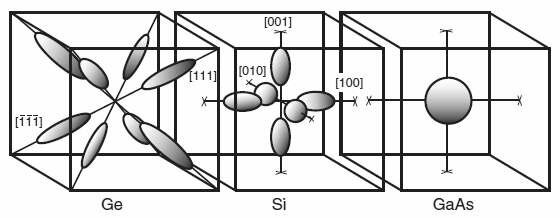
Figure 2.5: Minima of the conduction band of Si, Ge and GaAs
In Germanium, in contrast, the conduction band minimum is in the directions corresponding to the cube’s diagonal, and we have therefore 8 conduction band minima.
III-V Semiconductors (GaAs, InP, ..)
The band structure of III-V semiconductors is similar since the tetrahedral bonds have the same structure as the ones in Silicon or Germanium. In fact, the missing electron of the group III with the electron configuration 4s24p (for example Gallium) is provided by the column V element (for example Arsenic) of configuration 4s24p3 and these bonds have a low ionicity.
For a large number of III-V semiconductors, the bandgap is direct.
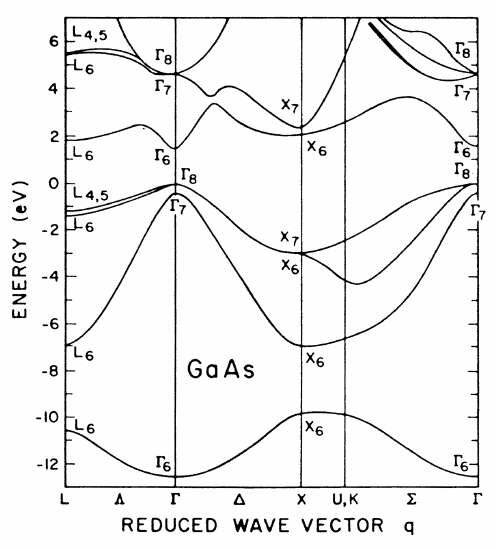
Figure 2.6: Structure de bande du GaAs
As an example, the computed band structure of GaAs is shown in Fig. 2.6.
Squirrel cage motors
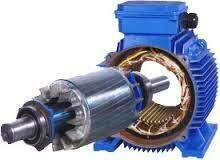 Modern electrical motors are available in many different forms, such as single phase motors, three-phase motors, brake motors, synchronous motors, asynchronous motors, special customised motors, two speed motors, three speed motors, and so on, all with their own performance and characteristics.
AC Motor control - Frequency converter
 A complete installation with a frequency converter controlled motor consists of a series of different components which should all be selected carefully for a given application.The components in an installation are selected according to the actual application, starting with selecting the right pump for the application.
Wavefunctions of the crystal - Bloch Theorem
The Hamiltonian of a semiconductor crystal has the translation symmetry
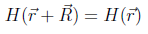
with  being a reciprocal lattice vector.
The Bloch theorem states that the wavefunctions have two “good” quantum numbers, the band index n and a reciprocal vector  such that the wavefunctions of the crystal may be written as:
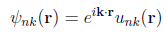
where  exhibits the periodicity of the crystal.
It may also be written as:

Proof of Bloch’s theorem
Translation operator

If R belongs to the Bravais lattice, the operator will commute with the Hamiltionian
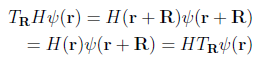
and therefore
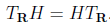
These two operators form a common set of commuting observable, we can therefore write the wavefunctions using eigenfunctions of both:

Consid´erons maintenant les propri´et´es de c(R)
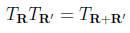
et donc

To simplify somewhat the notation, ai with i = 1, 2, 3 the basis vectors of the primitive Bravais lattice, and bi the basis vector of the reciprocal lattice. We can always define (because c(ai) is always normalized to unity:
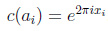
If now R is a translation of the Bravais lattice, it can be written as

then,
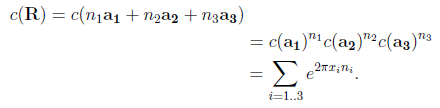
Using the orthogonality relations between the direct and reciprocal basis vectors, written as
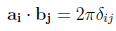
Considering the product between the vector R of the real space and the vector k of the
reciprocal space, written in the basis of the bi:
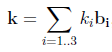
and then

It was in fact the result we had obtained for c(R), that was written as:

setting naturally xi = ki. The wavefunctions may well be written as:

that is one of the equivalent formulations of the Bloch theorem.
Electric motors make things go
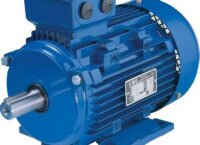
Electric motors make things go. Better motors mean better go power. What constitutes “better” and what to do about it, is the subject of a great deal of investigation. Better motors generally mean 2 things, higher efficiency and greater torque produced for a given amount of input power.
Direction of rotation and markings of terminals Three-phase motors
 The windings are connected in star(Y)-connection or in delta(Δ)-connection according to IEC 60034-8. This is done by wiring the terminal board as shown in the wiring diagram to the right. The marking of the terminal board is also defined in IEC 60034-8.
Read more: Direction of rotation and markings of terminals Three-phase motors