
Driving a 7-segment LED Display
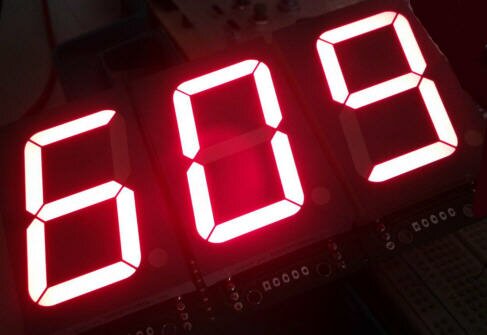 Although a 7-segment LED display can be thought of as a single display, it is still seven individual LEDs within a single package and as such these LEDs need protection from over current. LEDs produce light only when it is forward biased with the amount of light emitted being proportional to the forward current.
How to choose the right Connector
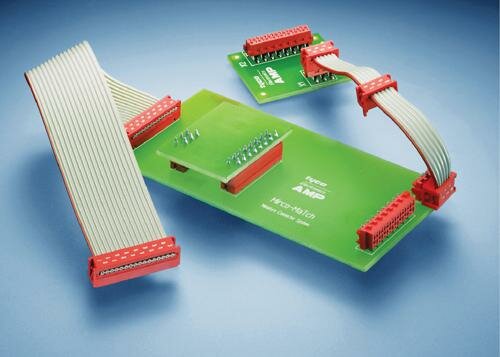
As it is important to choose the right connector for an embedded system, let us share some valuable advice from industry professionals.
PVDF Piezoelectric sensor
PVDF Piezoelectric sensor is an interesting, low-cost sensor that doesn’t need much processing to use, and has some unique characteristics.
The sensors looks like a small strip of plastic, and can be used for detecting movement or vibrations even into ultrasound. Such devices can help sense in many practical, real-world scenarios. They are extremely sensitive, low cost and easy to use.
LTC nano-power buck-boost DC/DC
What are the key needs of an Energy Harvesting (EH) power supply? Well, first of all, battery redundancy power needs to be available at times when the ambient power is not available. Of course, we want to extend battery life by harvesting ambient energy from thermal, vibration, solar, etc. To make the front end of our power supply more versatile, it would be useful to be able to convert both AC (piezo, magnetic, etc.) or DC (solar) energy transducers with a fairly wide voltage range and also to have an input prioritizer that could decide whether to use the energy harvesting input or the battery input.
A synchronous buck-boost would make a versatile power converter, and low quiescent current is a plus. Keeping the output regulated would be important when transitioning between ambient and battery power and vice-versa. A good, solid current output capability with possibility of different selectable output voltages would top off the wish list.
The LTC3330 does all of the above.
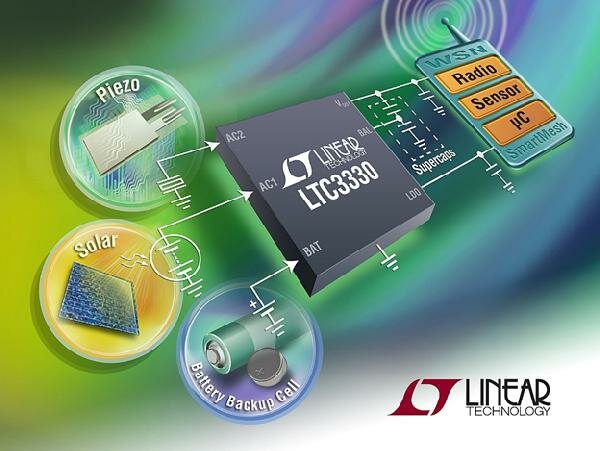
Linear Technology announced the LTC3330, a complete regulating energy harvesting solution that delivers up to 50mA of continuous output current to extend battery life when harvestable energy is available. The IC requires no supply current from the battery (Iq=0) when providing regulated power to the load from harvested energy and only 750 nA operating when powered from the battery under no-load conditions.
The regulator integrates a high voltage energy harvesting power supply, plus a synchronous buck-boost DC/DC converter powered by a primary cell battery to create a single non-interruptible output for energy harvesting applications such as those in wireless sensor networks.
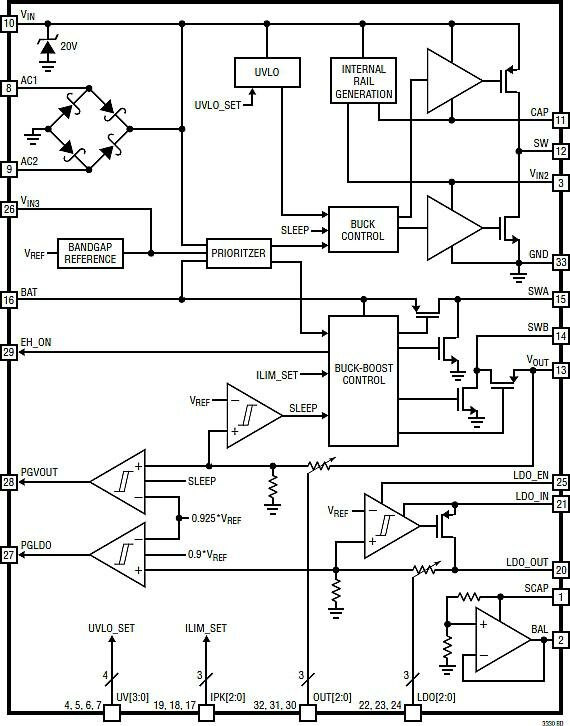
A comprehensive block diagram shows the high level of integration in this power supply
The energy harvesting power supply, consisting of a full-wave bridge rectifier accommodating AC or DC inputs and a high efficiency buck converter, harvests energy from piezoelectric (AC), solar (DC) or magnetic (AC) sources. The primary cell input powers a buck-boost converter that operates from 1.8V to 5.5V at its input when harvested energy is not available to regulate the output whether the input is above, below or equal to the output. The IC automatically transitions to the battery when the harvesting source is no longer available.
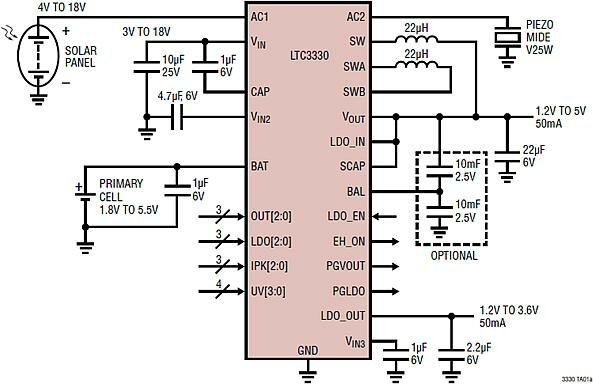
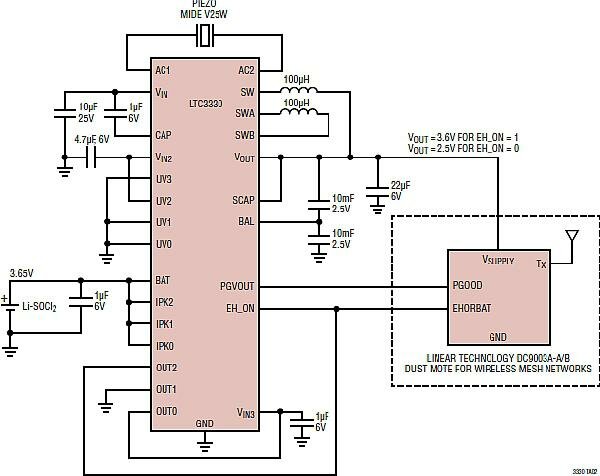
A typical application diagram
The device’s energy harvesting inputs operate from a voltage range of 3V to 19V, AC or DC, making it ideal for a wide array of piezoelectric, solar or magnetic energy sources. Its input under-voltage lockout threshold settings are programmable between 3V and 18V, enabling the application to operate the energy harvesting source at its peak power transfer point. Other features include programmable DC/DC nd LDO output voltage post-regulator for powering a microcontroller, buck-boost peak current limits, super-capacitor charger/balancer and an input protective shunt (up to 25mA at VIN >20V).
Supercapacitors could help electric car charge in a few minutes
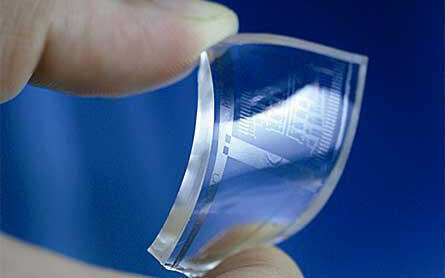 These are high performance supercapacitor electrodes. Left: field emission scanning electron microscope and transmission electron microscope micrographs; Right: sectional view of single hybrid nanostructure.
Read more: Supercapacitors could help electric car charge in a few minutes
Laser project 3-D display
A team of researchers from Japanese firm Aerial Burton have showed off focused pulse lasers with the ability to project a 3-D display in mid-air, even during daylight. Unlike other holographic projectors we’ve seen, it doesn’t require fog or steam to display the image and can be displayed using just air as the medium.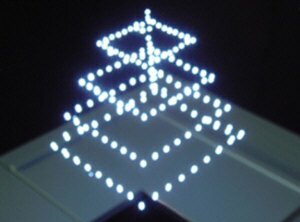
The big lie about LED lighting
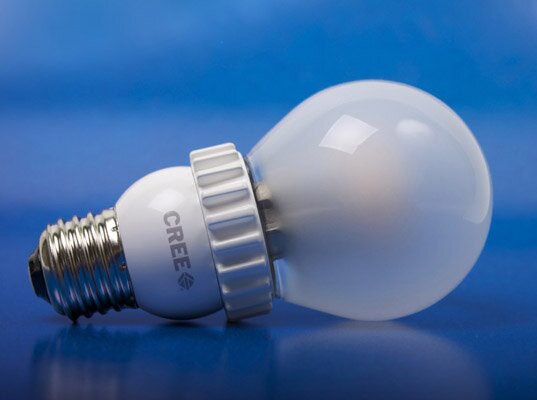 I've had it with LED lamps. The world has been told that LEDs are the future, in part because they are economically the right form of long-term lighting, and there are environmental benefits as a great aside. Well, maybe the environmental argument is true, but the economical one is not.
My wife has converted a substantial amount of our home lighting, as well as our holiday decoration lighting, to LED bulbs. Despite all this investment, I have yet to experience the primary benefit of long life. This made me sit down recently and ask myself why.